
Educational content. This article describes risk management frameworks commonly used in commodity trading; it does not constitute investment advice or recommendation. Examples are illustrative. Risk management practices depend on individual circumstances, goals, and risk tolerance. CFD trading carries significant risk of loss and may not be suitable for all investors.
Commodities risk analysis is how traders measure what they stand to lose before a gold spike or EIA release hits their position. This guide describes the risk types, volatility metrics, and management frameworks commonly discussed in commodity CFD trading.
Gold and oil don't move the way currency pairs do. They react to inventory reports, supply shocks, and inflation data in ways that have nothing to do with central bank differentials.
The exposure compounds fast. An EIA release can gap crude quickly enough to slip stops and spike margin before you've had time to reconsider your position. That's not bad luck. That's a different market.
A-Book execution removes one risk: your broker trading against you. It doesn't remove the market risk that comes with commodity volatility. That part is on you.
This guide describes how to measure and manage that exposure. It covers which drivers commonly move commodity prices, how position sizing relates to realised volatility, and how a repeatable risk process is typically structured. Understanding the risk on a position before placing the order is widely cited as a starting point.
What Is Commodity Risk?
Commodity risk is the financial exposure businesses and traders face from unpredictable changes in the price, supply, or availability of raw materials.
Commodity prices move on supply and demand imbalances at a global scale. When a major producer cuts output or demand surges from a large economy, prices shift fast.
Macroeconomic conditions add another layer. Inflation cycles, interest rate decisions, and currency strength all feed into where commodity prices settle.
External shocks make these moves sharper. A conflict in an oil-producing region, a drought cutting grain harvests, a regulatory shift in a mining country, or a sudden dollar rally can each reprice a commodity within hours. These forces don't announce themselves.
For retail traders, commodity risk is simpler but just as sharp. You hold a position and the price moves against you. With leverage, even a small move matters.
For CFD traders, leverage concentrates that exposure sharply. At 100:1, a $10,000 position requires only $100 in margin. A 1% adverse move erases that margin entirely. Depending on execution speed, the actual loss can exceed the initial deposit if the market gaps through the stop. Active management of this exposure is widely cited as a core element of commodity CFD trading practice.
Why Commodity Risk Management Matters
A single unhedged position through a major news release can end a trading account. Historically, XAUUSD has shown materially elevated intraday volatility around surprise FOMC decisions, with single-session moves in the $100-250 range on selected occasions according to historical price data. Past patterns do not guarantee future results. Traders holding overleveraged long positions with no stop-loss had no time to react.
The pattern repeats with oil, silver, and gas. A position sized for normal volatility gets destroyed by an inventory report or geopolitical shock. Most traders in this situation weren't underprepared on strategy. They were unprepared for how fast the move came.
A structured framework reframes reactive damage control as deliberate risk decisions. It typically covers five stages:
-
Risk identification: mapping each price exposure across open positions and the watchlist
-
Impact and likelihood assessment: ranking exposures by potential damage and probability
-
Mitigation: applying hedging, position sizing, or diversification to reduce the exposure
-
Monitoring: tracking key risk indicators (KRIs) continuously, not just at trade entry
-
Governance: defining rules for who decides when to cut, hedge, or hold
CFD traders speculating on Gold, Oil, and Silver face the same core price exposure as physical market participants. The framework applies to both.
Before building that framework, it helps to know exactly which type of risk you are dealing with.
Types of Commodity Risk
Commodity risk falls into several distinct categories, each driven by different forces. Price risk, supply and demand risk, and geopolitical and regulatory risk are the three core types covered below.
Price Risk
Price risk is the exposure to financial loss from unexpected changes in commodity prices driven by supply-demand shifts, geopolitical events, or market sentiment.
Price risk hits hardest in instruments with wide intraday ranges. XAU/USD (gold) moves $40-100 per session on average. WTI crude and UKOIL swing $1.50-4 per barrel in a single day. Agricultural commodities like wheat can gap sharply on a single weather report.
Oil is the obvious example. Political instability in a major producing region can cut supply overnight, pushing WTI crude up $3-6 per barrel before markets stabilize. Agricultural commodities work differently. A drought doesn't affect sentiment - it destroys the actual harvest, pushing wheat prices up before the season ends.
Unmanaged price risk shows up as positions held through sudden shocks. A trader holding a WTI crude position when an unexpected production cut is announced can see the price gap well beyond their planned exit before any action is possible.
Leverage makes this worse. On XAU/USD at 100:1, a $5,000 gold price means a 1% move equals $50/oz x 100 oz per lot = $5,000 loss on a 1-lot position - against just $50 in margin. That applies whether the trigger is an inventory report, a central bank decision, or a geopolitical headline.
The EIA (U.S. Energy Information Administration) releases weekly crude oil inventory data every Wednesday at 10:30 AM ET. This single report regularly moves WTI crude 2-4% within minutes of release.
Mini example (Oil on EIA): A trader holds a long WTI position ahead of Wednesday's report. Inventory data shows an unexpected 4 million barrel build. Oil drops $1.50 in under 3 minutes. On one WTI futures contract (1,000 barrels), that is a $1,500 loss against the position before the trader can act.
For a structured weekly process using EIA data, COT reports, and CPI releases, see the commodity fundamental analysis guide.
Supply and Demand Risk
Supply and demand risk is the exposure to price and availability disruptions when production, logistics, or consumption patterns shift unexpectedly.
Supply imbalances trace back to three main sources: crop failures, sanctions, and infrastructure disruptions. A drought in a major wheat-producing region cuts output before harvest. Port closures and pipeline breaks create the same problem from the logistics side, stopping product from reaching buyers even when stocks exist.
The Russia-Ukraine conflict showed how quickly this becomes physical. Russia and Ukraine together supply roughly 30% of global wheat exports, and the 2022 invasion froze Black Sea shipments almost overnight. European TTF natural gas prices rose from roughly €20/MWh in early 2021 to over €300/MWh by August 2022 as Russian supply was cut.
Price risk and supply-demand risk are related but not the same thing. Price risk is about market valuation moving against your position: a contract you hold falling in value because of sentiment, interest rates, or currency shifts.
Supply-demand risk is more fundamental. It is about whether the physical commodity is available at all, or whether a sudden glut means buyers cannot move what they have.
The two risks connect over time. A sustained shortage pushes prices up as buyers compete for scarce supply, creating direct price exposure for anyone without fixed contracts. A structural glut does the opposite, depressing prices for months or years and eroding margins for producers holding inventory.
Geopolitical and Regulatory Risk
Geopolitical and regulatory risk is the threat of supply disruptions, price swings, and compliance costs from political conflicts, sanctions, trade disputes, and regulatory changes.
Wars, sanctions, and trade disputes cut supply chains fast. A conflict near a major production region can halt exports overnight, restrict market access, and send commodity prices sharply higher or lower within hours.
Roughly 20% of the world's oil passes through the Strait of Hormuz. Any military tension there pushes crude prices up immediately, before a single barrel is actually disrupted. Sanctions on major producers like Russia and Iran have historically removed significant supply from global markets, forcing buyers to find alternatives and repricing the market in the process.
Regulatory changes can hit commodity traders from three directions: environmental laws, trade restrictions, and financial market regulations.
-
Environmental laws - new emissions caps or carbon pricing that raise production costs
-
Trade restrictions - tariffs, export bans, or import quotas that reshape supply flows
-
Financial market regulations - leverage limits, reporting requirements, or CFD restrictions imposed by regulators like ESMA or ASIC
Fossil fuels show how this works in practice. The EU Emissions Trading System (EU ETS) carbon price exceeded €100 per tonne in 2023, directly raising production costs for European energy producers. For traders, tightened emissions rules translate into reduced liquidity in energy CFDs and wider spreads during periods of major policy change.
Understanding which type of risk is driving a move matters. You also need a way to measure how large that move could be. That is where volatility metrics come in.
How to Measure Commodity Price Volatility
Commodity price volatility is measured using statistical metrics applied to historical price data and forward-looking market indicators. The two main approaches are historical volatility metrics (standard deviation, coefficient of variation) and implied volatility derived from options pricing. These metrics complement the chart-based tools covered in commodity technical analysis.
The time horizon you choose changes the volatility result you get. Day traders work with lookbacks as short as a single day, while supply-chain managers rely on monthly or annual intervals to assess longer-term risk. A full picture uses all three frequencies: weekly, monthly, and annual.
Historical Volatility Metrics
Historical volatility in commodities is most commonly quantified using standard deviation, the coefficient of variation (standard deviation divided by average price), and absolute percentage change over a defined lookback period.
| Metric | What it measures | Best used for | Key limitation |
|---|---|---|---|
| Standard Deviation | Price dispersion around the mean over a chosen period | Comparing volatility within one commodity over time | Shows internal variability only - no directional trend |
| Coefficient of Variation (CV) | Standard deviation divided by average price | Comparing volatility across commodities at different price levels (e.g. gold vs corn) | Can be misleading during extreme price regime shifts |
| Absolute Percentage Change | Net directional price movement over a period | Measuring total price travel, independent of internal fluctuations | Hides the internal swings that occurred along the way |
Three historical metrics each reveal something different. Standard deviation measures how much prices scatter around their average over a period - a higher value means wider swings and greater uncertainty. The coefficient of variation (CV) normalizes standard deviation by the average price, so you can compare volatility across commodities with very different price levels, like gold at $5,000/oz versus corn at $5/bushel. Absolute percentage change shows the net directional move over a period, capturing how far prices actually travelled in total, regardless of internal fluctuations.
Standard deviation alone only describes how much a price bounced around internally. It tells you nothing about whether prices ended up sharply higher or lower. Combining CV and absolute percentage change into a single synthetic indicator captures both dimensions: internal variability and overall directional intensity.
Implied Volatility and Market Indicators
Implied volatility (IV) is the market's forward-looking expectation of price volatility, extracted from the current prices of commodity options contracts, in contrast to historical volatility which looks backward at realized price movements.
Implied volatility (IV) is derived by reverse-engineering an options pricing model. Take the Black-Scholes formula, plug in the current market price of an option, and solve for the volatility input that produces that price. The result is IV: the market's live estimate of how much an asset will move.
Three indices track commodity IV directly:
-
OVX - CBOE Crude Oil Volatility Index, measuring 30-day IV on WTI crude oil options. OVX spikes have preceded major oil price dislocations by 1-3 trading sessions, making it a leading risk gauge for energy traders.
-
GVZ - CBOE Gold Volatility Index, the equivalent fear gauge for gold options.
-
CME Group options - the standard reference for agricultural commodity IV, covering grains, softs, and livestock.
IV reacts to news instantly. When OPEC announces a production cut or a crop report surprises the market, IV jumps within minutes. Historical volatility, calculated from past price data, can lag by days or weeks before reflecting that shift.
For leveraged CFD traders, an OVX spike is commonly described as an early warning signal rather than a confirmation. When OVX rises sharply, one widely cited response is to reduce position size or tighten stop-loss levels before historical volatility metrics catch up. Acting on IV provides a window to manage risk before the move lands in the data. The Vanto economic calendar lists scheduled releases that may be driving an IV spike.
Volatility by Commodity Type
Energy commodities are the most volatile commodity type, with metals, food, and precious metals ranking progressively lower in volatility.
These PricePedia volatility scores measure average annual price fluctuation as a percentage within each category.
| Commodity Category | 2015-2019 Score | 2020-2024 Score | Change |
|---|---|---|---|
| Energy | 18.41 | 27.63 | +9.22 |
| Wood and Paper | 9.87 | 13.18 | +3.31 |
| Food | 7.94 | 10.86 | +2.92 |
| Textile Fibers | 8.12 | 10.79 | +2.67 |
| Industrial Metals | 10.23 | 12.61 | +2.38 |
| Precious Metals | 8.65 | 10.74 | +2.09 |
| Chemical Products | 7.41 | 9.38 | +1.97 |
| Cereals | 9.18 | 11.02 | +1.84 |
| Tropical Foods | 6.73 | 8.44 | +1.71 |
Post-pandemic events did permanently shift commodity volatility. All nine categories recorded higher scores in 2020-2024 than in 2015-2019, with energy posting the largest jump at +9.22 points.
Two forces drove the increase. Geopolitical instability in oil-producing regions pushed energy prices into wider swings. Weather-driven crop failures disrupted agricultural supply chains, lifting food and textile fiber volatility by +2.92 and +2.67 points respectively. Wood and Paper rose +3.31 points, reflecting pandemic-era supply chain breakdowns.
Higher baseline volatility across all categories means position sizing needs to account for a structurally wider range of price moves than pre-2020 data would suggest.
Commodity Risk Management Strategies
The main commodity risk management strategies are hedging with derivatives, diversification and position sizing, and supplier and procurement controls. Each addresses a different dimension of exposure: price volatility, portfolio concentration, and supply chain reliability. For specific entry and exit setups, see the commodities trading strategies guide.
Hedging With Derivatives
Hedging with derivatives is using futures, options, or swaps to lock in prices and offset losses from adverse commodity price movements.
| Instrument | Mechanism | Cost | Best suited for |
|---|---|---|---|
| Futures | Lock in a fixed price at a future delivery date | Exchange fees + margin deposit | Producers and large physical market participants |
| Options | Right (not obligation) to buy or sell at a strike price | Premium paid upfront | Traders wanting downside protection while keeping upside |
| Swaps | Exchange a floating price for a fixed rate over a set period | Counterparty or bank fees | Producers needing long-term cash flow stability |
| CFDs | Open an opposing position to offset existing exposure | Spread + commission (Raw accounts from 0.0 pips) | Retail traders - flexible sizing, no expiry, low margin |
Futures lock in a selling price before delivery. An oil producer expecting to sell 1,000 barrels in three months can short a futures contract today at $95/barrel. If spot prices fall to $85 by settlement, the futures position covers the difference.
Options give the right, but not the obligation, to buy or sell at a set price. A gold trader holding a long position can buy a put option at $4,800/oz. If gold drops to $4,500, the put pays out. If gold climbs to $5,200, they skip the option and take the upside.
Swaps exchange a floating price for a fixed one over a set period. A natural gas producer expecting volatile prices can swap into a fixed rate for 12 months, stabilizing cash flow regardless of where spot prices land.
CFD-based hedging works by opening an opposing position to offset an existing exposure. Hold a long position on Gold worth $10,000? A short CFD on Gold of equal size neutralizes the price risk while you wait for market conditions to clarify. With 100:1 leverage, that $10,000 short requires only $100 in margin.
| Instrument | Contract size | Tick size | Tick value (per lot) | Typical daily range |
|---|---|---|---|---|
| XAU/USD (Gold) | 100 troy oz | $0.01/oz | $1 per lot | $40-100 (about 0.8-2%) |
| UKOIL (Brent) | 100 barrels | $0.01/bbl | $1 per lot | $1-3 (about 1-3%) |
Broker execution conditions are one factor that affects how hedges perform during volatile moves. Vanto operates an A-Book execution model, with orders routed directly to liquidity providers.
Hedging caps both sides. The hedge position offsets adverse price moves, but it also offsets favorable ones. Lock in a selling price with a futures short and you won't benefit if the commodity surges 20% before delivery.
Common mistake: sizing the hedge incorrectly.
If a trader holds a $5,000 long on Gold and opens a $10,000 short, the risk is not neutralised; it is reversed. The resulting position is net short $5,000 and exposed in the opposite direction. Hedge sizing is commonly matched to the underlying exposure rather than exceeding it.
Diversification and Position Sizing
Diversification and position sizing reduce commodity risk by spreading exposure across multiple markets and limiting the capital allocated to any single trade or commodity.
Spreading your trades across different commodities reduces your exposure to any single event. If your entire portfolio is in oil and a geopolitical ceasefire collapses the price, every position suffers at once.
Oil and agricultural commodities tend to move on different drivers: oil reacts to geopolitical tension and production decisions, while wheat or corn prices swing on weather and harvest data. Because those forces rarely strike at the same time, holding both reduces the chance that all your positions draw down together.
Position sizing is commonly defined as risking a fixed percentage of account equity on each trade rather than a fixed dollar amount selected by feel. On a $1,000 account at 1% risk per trade, the maximum per-trade loss is $10. Risk-per-trade conventions commonly reference 1-2% as a starting point; appropriate risk depends on individual circumstances.
Here is an illustrative lot-size calculation on Gold (XAU/USD) with a 15-pip stop-loss:
-
Each 0.01 lot moves $0.10 per pip
-
15 pips x $0.10 = $1.50 risk per 0.01 lot
-
$10 max loss / $1.50 = 0.06 lots
Under this framework, lot size is determined by the risk limit rather than by conviction in the trade. On Vanto's MT5, the minimum lot size on XAU/USD is 0.01 lots, allowing sizing to match a range of account balances without breaking the calculation.
Supplier and Procurement Controls
Supplier and procurement controls are risk management practices that reduce commodity exposure through supplier diversification, long-term contracts, and sourcing redundancy to buffer against supply disruptions and price shocks.
This section applies mainly to physical commodity businesses. CFD traders may skip ahead to position sizing.
-
Supplier diversification - sourcing from multiple geographies so a single regional disruption does not halt supply entirely
-
Long-term fixed-price contracts - locking in commodity costs for a set period, which limits spot market exposure without financial derivatives
-
Qualifying backup suppliers - pre-approving secondary suppliers, which allows faster sourcing transitions without accepting distressed spot prices
-
Strategic inventory buffers (safety stock) - holding reserve stock to absorb short-term supply shocks while alternate sourcing is activated
Financial hedges and procurement controls solve different problems. Futures and options address price risk on traded markets. Procurement controls address supply availability and cost stability at the operational level. Both are needed for full commodity risk coverage.
For CFD traders, the equivalent of procurement controls is commonly described as pre-planning: defining entry conditions and maximum position size before high-risk events such as EIA inventory reports or OPEC meetings. Pre-planning is widely cited as a way to avoid making size decisions under pressure when prices are already moving.
Building a Commodity Risk Management Framework
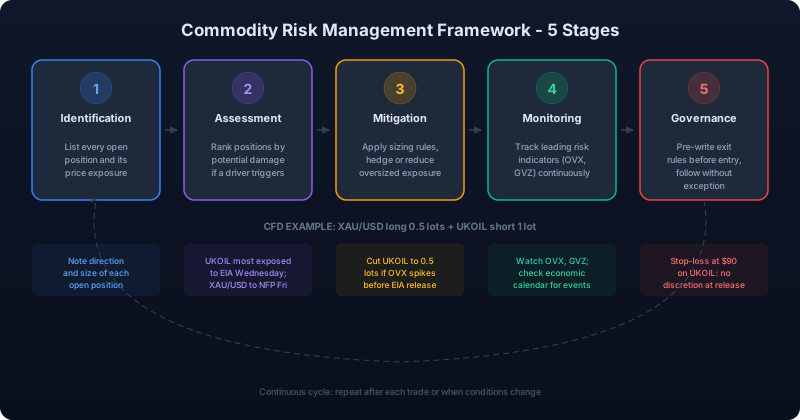
The five stages map directly to open positions:
| Stage | Activity in this stage | Commodity CFD example |
|---|---|---|
| 1. Identification | Listing each open commodity position and its price exposure | XAU/USD long 0.5 lots, UKOIL short 1 lot - noting direction and size |
| 2. Assessment | Ranking positions by potential damage if a key driver triggers | UKOIL most exposed to Wednesday EIA; XAU/USD to NFP Friday |
| 3. Mitigation | Applying position sizing rules; hedging or reducing oversized exposure | Cutting UKOIL to 0.5 lots if OVX spikes before EIA release |
| 4. Monitoring | Tracking leading risk indicators throughout the trade | Watching OVX and GVZ; checking Vanto economic calendar for scheduled events |
| 5. Governance | Defining the exit rule before entry and adhering to it | Stop-loss at $90.00 on UKOIL - pre-defined level applied at release time |
-
Identification: Listing every XAU/USD and UKOIL trade open in MT5.
-
Assessment: Ranking which position carries the largest downside if UKOIL gaps on an OPEC headline or XAU/USD whipsaws after a US data release.
-
Mitigation: Applying the position sizing rule and reducing size to what the account can absorb at current volatility.
-
Monitoring: Watching OVX and GVZ as early warning signals during the trade.
-
Governance: Defining the stop or invalidation level before entry, with the pre-defined level applied consistently.
Broker conditions affect how well the framework works in practice. On a Raw account, spreads start from 0.0 pips, which cuts the cost of entering and exiting hedges.
Sub-28ms execution means your stops fill close to the level you set, even during fast commodity moves. Vanto operates an A-Book routing model, with orders sent directly to liquidity providers.
Open a Vanto demo account and practise the five stages on live XAU/USD or UKOIL prices with zero capital at risk. Fund when ready, starting from $25.
Common Questions About Commodity Risk
What is the risk of commodities?
Commodity risk is the exposure to financial loss from unpredictable price movements in raw materials like oil, gold, or wheat.
Prices shift on supply disruptions, geopolitical events, currency moves, and seasonal demand cycles. A gold position can swing hundreds of dollars per ounce in a single session.
For CFD traders, leverage amplifies every move. A 1% price shift on a leveraged position can wipe out 10-20% of your margin in seconds.
What is an example of a commodity risk?
A commodity risk example is a trader holding crude oil CFDs when OPEC announces an unexpected production cut, sending prices sharply against their position.
Say a trader goes short on crude oil expecting prices to fall. OPEC announces a surprise production cut overnight, and oil gaps up 6% at the open. The position hits maximum loss before a stop-loss can trigger cleanly.
The 2022 Russia-Ukraine conflict shows systemic commodity risk. Russia and Ukraine together supplied roughly 30% of global wheat exports. When that supply froze, wheat futures surged and traders holding short positions absorbed severe losses regardless of their technical analysis.
How is commodity risk commonly managed?
Commodity risk management approaches vary; commonly cited frameworks combine position sizing, pre-planned stop-losses, and adjustment around high-impact news events.
Position sizing is widely cited as the first layer of risk management. The 1-2% convention references risking no more than 1-2% of account equity on any single trade as a starting point; appropriate risk depends on individual circumstances.
Stop-loss levels are commonly defined before entry rather than after the trade is open. Deciding the exit point at entry is often described as a way to limit losses to a pre-defined amount, although fills during fast moves can still differ from the set level.
Closing or reducing positions ahead of scheduled high-impact events such as OPEC meetings, USDA crop reports, or central bank decisions is one widely discussed approach. Volatility spikes during these windows can move price beyond stop levels before execution completes. Broker execution model and order routing are among the factors traders commonly consider when selecting a broker.
Related guides. For the wider context behind these controls, start with how to trade commodities, then narrow into instrument-specific tactics with the Brent oil trading strategy and day trading commodities guides, both of which lean on the volatility and position-sizing rules covered above. To sharpen the mechanics, the glossary explains margin, the deposit that leverage puts at risk, and slippage, why a stop can fill away from its set level during fast commodity moves.