
Educational content. This article describes strategy frameworks commonly used in commodity trading; it does not constitute investment advice. Entry/exit examples are illustrative. Past patterns do not guarantee future results. CFD trading involves significant risk of loss.
Commodity trading involves rules and conventions commonly cited in trading literature. If you're still learning the basics, our commodities trading for beginners guide covers introductory material.
This guide describes 6 commodity strategy frameworks with illustrative entry, stop-loss, and take-profit examples for gold and oil. Each framework is associated with a market condition where it is commonly applied. None of these frameworks guarantees a profitable outcome, and all leveraged positions carry the risk of loss.
Strategies can be tested on a demo account before any live capital is committed.
What Is a Commodity Trading Strategy?
A commodity trading strategy is a repeatable plan with specific rules for when to enter, exit, and manage risk on trades in commodities like gold, oil, or silver.
A plan is commonly cited as a way to reduce reaction to market noise: rules based on data and analysis in place of impulsive decisions.
A commodity trading strategy defines four core elements: entry rules (when to open a position), exit rules (take-profit and stop-loss levels), position sizing (the dollar or percentage amount you risk per trade), and the market conditions where the approach is commonly applied. For example, with 1:100 leverage on a commodity CFD, you control a $10,000 crude oil position using just $100 in margin, but this magnifies both potential gains and losses.
Which Commodities Are Commonly Studied First by Newer Traders?
Gold, oil, and silver are among the commodities most frequently studied by newer participants because of high liquidity, extensive news coverage, and price trends that can be easier to identify on charts. Each carries distinct volatility characteristics and significant risk of loss.
Gold, oil, and silver are frequently referenced in introductory material because they are highly liquid markets with continuous news coverage. When the Fed adjusts interest rates, gold typically reacts. When OPEC announces production cuts, oil typically reacts. These observable catalysts provide context for price movements rather than trading without a frame of reference.
Commodity CFDs let traders speculate on price movements without buying physical assets - our guide on how to trade commodities online covers the mechanics. Go long if you think gold will rise, short if you expect oil to fall. The Vanto Standard Account offers commission-free trading for practicing strategies on MT5.
Six Commodity Strategy Frameworks
Trend Following
Trend following is a framework that identifies a commodity's directional momentum and signals entries in that same direction until reversal signals appear.
Trends are commonly identified using moving averages. When the 50-day MA crosses above the 200-day MA, that is commonly interpreted as an uptrend signal. When it crosses below, the trend may have reversed.
This framework is commonly applied during prolonged directional moves driven by macro factors. Gold and oil often show clearer trends when inflation rises, interest rates shift, or supply gets disrupted. Past market behaviour does not guarantee future results.
Illustrative gold example: If gold trades above its 50-day MA around $4,900, the framework signals a long entry.
-
Entry: Illustrative long around $4,900 when price crosses above the 50-day MA
-
Stop-loss: Illustrative stop around $50 below entry at $4,850 to define downside
-
Take-profit: Illustrative exit at the next resistance level or at a 2:1 reward-to-risk ratio (around $5,000)
The stop-loss caps the per-trade loss if the trend does not continue. A 2:1 ratio corresponds to defining $50 of downside against $100 of potential upside. Examples are illustrative only; past patterns do not guarantee future results.
Range Trading
Range trading is buying at support and selling at resistance when commodity prices move sideways without a clear trend.
Confirming a range: Look for at least two touches of both support and resistance on the daily chart. Price should bounce between these levels repeatedly with no clear trend in either direction.
Basic rules: Traders applying this framework commonly buy near support and sell near resistance, placing the stop-loss just outside the range boundary because breakouts happen. Unlike trend strategies, you can trade both directions depending on where price sits within the range.
When it fails: Breakouts through support or resistance invalidate the range. Tight ranges often don't justify the risk because the stop-loss eats most of the potential profit.
Illustrative WTI oil example:
-
Identify the range: WTI trading between $60 support and $66 resistance
-
Entry: Illustrative long around $60.50 when price touches support
-
Stop-loss: Illustrative stop at $59 (just below support to define downside on a breakdown)
-
Take-profit: Illustrative exit at $65.50 (just before resistance, ahead of a possible reversal)
Examples are illustrative only; past patterns do not guarantee future results.
Breakout Trading
Breakout trading is entering a position when price moves decisively above resistance or below support, betting the move will continue rather than reverse.
Watch for price consolidating near a key resistance or support level. The longer it holds that level, the stronger the breakout signal when volume picks up and price pushes through. Higher volume confirms the move. Without it, the breakout may be weak and reverse quickly.
Range trading bets on the bounce: buy at support, sell at resistance. Breakout trading does the opposite. You wait for price to break through support or resistance, then trade the continuation beyond that level. You're not catching the bounce; you're riding the break.
False breakouts are the main risk. Price breaks through, you enter, then it reverses back into the range and stops you out. Breakouts also offer limited opportunities since most commodities trend or range for extended periods. Traders applying this framework commonly combine it with trend following or range strategies across different market conditions.
Illustrative Gold Breakout Example
-
Gold consolidates near $4,950 resistance for several sessions.
-
Place a Buy Stop order at $4,960 (just above resistance) to enter only if price breaks through.
-
Set the stop-loss at $4,920 (below the consolidation zone) to define the per-trade loss if the breakout fails.
-
Illustrative take-profit at $5,010 ($50 above entry), associated with the initial momentum window.
-
Monitor volume on the breakout. Strong volume is commonly interpreted as confirmation; weak volume suggests caution.
Examples are illustrative only; past patterns do not guarantee future results.
Seasonal Trading
Seasonal trading frameworks reference recurring price patterns associated with supply-and-demand cycles. Weather, harvest periods, and seasonal consumption are commonly cited as factors when historical patterns repeat. Past patterns do not guarantee future results.
Several commodities have historically shown seasonal patterns:
• Crude oil demand rises in winter for heating and peaks again in summer as travel increases
• Heating oil prices climb heading into winter months when heating demand spikes
• Agricultural commodities drop at harvest (abundant supply) and rise during planting or growing seasons
Study historical price data to spot patterns caused by weather and harvest cycles. Look at average price movements across specific months and holiday seasons. Compare the same time periods over multiple years to confirm the pattern repeats consistently.
Seasonal patterns aren't guaranteed. Markets change, and unexpected events disrupt historical cycles. Seasonal analysis is commonly combined with technical confirmation such as trend indicators or support levels before entering trades, and is commonly treated as one factor among several rather than the only one.
Illustrative Crude Oil Winter Seasonal Example
-
Entry: Illustrative long on a crude oil CFD in late October when historical data shows demand has typically started rising for winter heating
-
Stop-loss: Illustrative stop 3% below entry price to define downside if the pattern does not repeat
-
Take-profit: Illustrative exit in mid-December when winter demand has historically peaked, targeting 5-8% gain
-
Position size (illustrative): A 2% risk model would size this position so the stop-loss exposes 2% of total capital
Examples are illustrative only; past patterns do not guarantee future results.
Spread Trading
Spread trading means taking opposite positions in two related commodities at the same time. You profit from the price difference between them, not from predicting which direction the market will move.
Calendar spreads (also called intra-commodity spreads) involve buying one contract month and selling another month of the same commodity. For example, buying January heating oil while shorting May heating oil.
Inter-commodity spreads pair two related commodities. You go long on one and short on the other. Buying gold while shorting silver when you expect gold to outperform silver is a common example.
True calendar spreads require futures contracts. If you trade CFDs, you can apply spread logic using correlated pairs like gold/silver or WTI/Brent crude instead.
In some market conditions near-month contracts move more than later months, because they're closer to delivery and more sensitive to immediate supply and demand; the relationship depends on the term structure.
A bull spread exploits this: buy the near-month contract, sell the far-month. When the near-month gains value faster, the spread widens and you profit from the difference.
A heating oil bull spread bets on winter demand widening the price gap between near-term and later contracts. You buy January heating oil at $2.50/gallon and sell May heating oil at $2.43/gallon.
If January rises to $2.65 and May rises to $2.56, your spread profit is $0.02/gallon ($0.15 gain on January minus $0.13 gain on May); the spread itself widened from $0.07 to $0.09. Exit when the spread hits your target width, or when winter passes and the seasonal catalyst ends.
Spread trading is commonly described as reducing directional exposure, because both positions move with the overall market; the relationship can break down and both legs can lose. The profit comes from the relative movement between contracts, not from predicting whether commodities crash or rally.
The tradeoff: smaller spread changes mean lower reward per contract. A $0.02/gallon spread profit requires larger position sizes than a $0.15 outright move to generate the same dollar gain.
For CFD traders simulating spreads (long gold, short silver), overnight fees on two positions add up quickly. Factor financing costs into your spread profit calculation before entering.
Illustrative example: gold vs silver inter-commodity spread
-
Entry: Gold trading at $4,950/oz, silver at $78/oz. The framework signals a long position in gold relative to silver; illustratively, 1 lot long gold CFD against 1 lot short silver CFD.
-
Stop-loss: Illustrative spread limit. If silver outperforms gold by more than 2% (a per-trade risk threshold), close both positions to cap the spread loss.
-
Take-profit: Close when the spread widens to a defined target. For example, if gold gains 3% while silver gains only 1%, the spread captures a 2% differential.
-
Exit timing: Monitor the correlation. If gold and silver move in opposite directions (correlation breaks down), the framework signals exiting both legs regardless of profit/loss.
Examples are illustrative only; past patterns do not guarantee future results.
Day Trading
Day trading means opening and closing all commodity positions within the same trading day. No overnight holds. You capture intraday price swings and exit before the market closes.
Two intraday techniques are commonly cited in commodity day trading:
• Momentum trading uses moving averages, RSI, and MACD to spot strong price movements and ride them for quick gains
• Scalping involves making dozens of small trades throughout the day to profit from minor price fluctuations and bid-ask spreads - see our 5-minute gold scalping strategy for a specific setup
Both require speed. The opportunities last minutes, not hours.
Day trading demands fast decisions, significant screen time, and understanding leverage risk. You must react to market shifts within seconds.
CFDs amplify this intensity. With 1:100 leverage, you control a $10,000 position with just $100 margin. A 1% price move means a $100 gain or loss, equal to your entire margin. Gains multiply fast. So do losses.
Day trading is commonly cited as the most demanding of the 6 frameworks covered in this guide, because tolerance for volatility is difficult to gauge before real money moves this fast.
Illustrative intraday gold example:
-
Entry: Gold breaks above $4,960 resistance at 9:15 AM with volume confirmation
-
Stop-loss: Illustrative stop at $4,955 (5-point risk)
-
Take-profit: Illustrative target at $4,975 (15-point target, 3:1 reward-to-risk ratio)
-
Exit: Close position by 3:00 PM regardless of price to avoid overnight exposure
On 0.1 lot the setup defines $50 of downside against $150 of potential upside. Examples are illustrative only; past patterns do not guarantee future results. Holding through market close exposes day-trading positions to overnight gap risk.
How Traders Commonly Match Frameworks to Conditions
Strategy choice is commonly informed by market conditions, available monitoring time, and individual risk tolerance.
Market conditions change. Trending gold markets are commonly associated with trend-following frameworks; ranging crude oil markets are commonly associated with range-trading frameworks. Identifying the current regime narrows the relevant frameworks.
Time availability and risk tolerance further inform the choice. Day-trading frameworks require active screen time with tighter stops. Trend-following frameworks involve less daily monitoring and wider swings. Whether a framework is suitable depends on individual circumstances, trading goals, and risk tolerance.
Look at the price chart over the last 20-30 days.
Trending markets show consistent higher highs and higher lows (uptrend) or lower highs and lower lows (downtrend). Each swing moves further in one direction. Trend following frameworks are commonly applied in these conditions.
Ranging markets show price bouncing between defined support and resistance levels. Price tests the same ceiling and floor repeatedly without breaking through. Range trading and mean reversion are commonly applied in these conditions; scale trading is a systematic approach commonly associated with range conditions.
Volatile/breakout markets show price consolidating in a tight range before sharp moves. Look for narrowing price action followed by volume spikes. This is commonly interpreted as a breakout-trading context.
Day trading requires active screen time during market hours. You need to monitor entries, manage stops, and close positions before the session ends.
Trend following and seasonal strategies need only daily check-ins. Spend 15-30 minutes reviewing charts, adjusting stops, and placing orders. The positions do the work while you're away.
Framework choice depends on individual trading style, specific goals, and circumstances. With only 30 minutes available daily, day-trading frameworks are typically not practical. With 2+ hours of active market time, day-trading frameworks become more feasible to apply.
Tight-stop frameworks (risking 1-2% per trade) are commonly associated with day trading and breakout setups. Exits happen quickly when price moves against the position; participants applying these frameworks typically accept frequent small losses as part of the statistical profile.
Wider-stop frameworks are commonly associated with trend-following and range-trading approaches. Stops sit further from entry, allowing positions room to absorb normal volatility. Fewer trades occur, and per-position moves are larger.
Reviewing performance over time helps identify which markets and frameworks an individual finds most consistent to execute. Commodity CFDs allow speculation on price movements without purchasing physical assets, with profit and loss on both rising and falling prices. Whether any framework is appropriate depends on individual circumstances, risk tolerance, and trading goals.
Match Strategy to Market Conditions
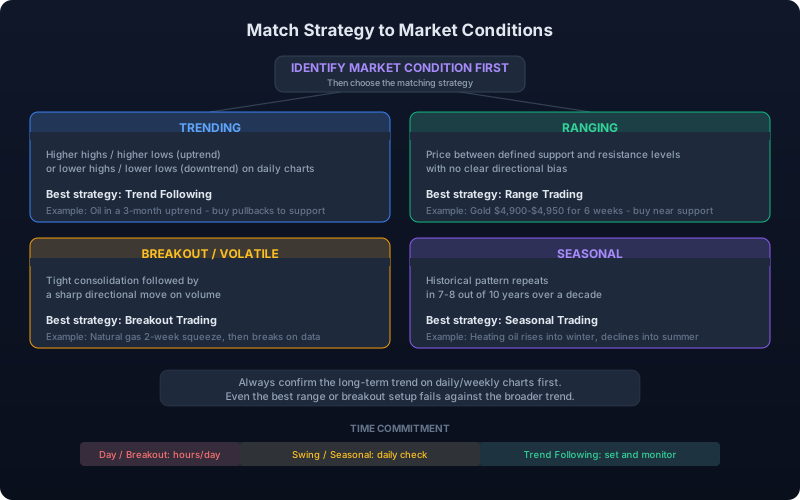
Different market conditions are commonly associated with different framework approaches:
| Market Condition | How to Identify | Commonly Applied Framework | Illustrative Example |
|---|---|---|---|
| Trending | Higher highs and higher lows (uptrend) or lower highs and lower lows (downtrend) on daily/weekly charts | Trend following | Crude oil in a 3-month uptrend: long entries on pullbacks to support |
| Ranging | Price trades between defined support and resistance levels with no clear directional bias | Range trading | Gold bouncing between $4,900 and $4,950 for 6 weeks: entries near support, exits near resistance |
| Breakout/Volatile | Price consolidates in a tight range before making a sharp move | Breakout trading | Natural gas compresses for 2 weeks, then breaks out on inventory data |
| Seasonal | Historical patterns repeat consistently across multiple years | Seasonal trading | Heating oil has historically risen into winter months when demand peaks, declining into summer |
Trend direction on daily or weekly charts is commonly checked before acting on shorter-term signals, because a range or breakout setup that contradicts the broader trend is more likely to fail.
Consider Your Time and Risk Tolerance
Each strategy demands a different time commitment:
• Day trading → hours per day of active monitoring during market hours
• Swing trading and seasonal trading → daily check-ins, positions held for days to weeks
• Trend following → set once and monitor, minimal daily intervention
Risk management comes down to position sizing. A ceiling of 1-2% of account equity per trade is widely cited in trading literature; the arithmetic limits the loss carried by any single trade. Leverage amplifies both gains and losses: with 1:100 leverage, a $100 margin controls a $10,000 position. A 1% move against you wipes out your margin.
Day trading requires hours of screen time. You enter and exit positions within the same day, which means watching price action continuously during market hours.
Swing and seasonal traders check positions once daily. Trades stay open for days to weeks based on larger patterns, so you don't need constant monitoring.
Trend following is the most hands-off. Set your entry, stop-loss, and take-profit once, then let the trade run with minimal intervention.
A 1-2% risk-per-trade guideline is widely cited in trading literature, particularly for participants newer to commodity markets. The arithmetic limits the dollar loss per trade and preserves account equity across a series of trades.
Leverage multiplies both wins and losses. With 1:100 leverage, a $100 margin controls a $10,000 position. If the trade moves 1% against you, your entire $100 margin is gone. Position sizing determines how much of account equity a stopped-out trade costs.
How to Start Practicing Commodity Strategies
Before trading live capital, two practical steps are commonly cited: testing the chosen framework on a demo account with live market data, and understanding how spreads and overnight fees affect realised outcomes.
Consistent execution of any framework is commonly cited as more impactful than searching for a 'perfect' strategy. A simple trend-following approach executed with clear rules is commonly more practical than complex systems that are difficult to apply consistently. The subsections below cover the details of each practice step.
You need a trading platform that offers demo accounts with live market data. MT5-based platforms like Vanto provide this - you practice with real price movements without risking money.
With commodity CFDs, you'll practice using leverage. For example, you control a $10,000 position with just $100 in margin. This amplifies both gains and losses, so demo practice lets you experience how leverage affects your strategy before real money is at stake.
Practice until you can execute your chosen strategy consistently with clear entry, stop-loss, and take-profit levels. Whether you picked trend following, range trading, or breakout trading, you should be able to apply the rules without hesitation.
Demo practice is commonly continued until execution is consistent across a series of trades. This builds the discipline to follow your plan when real money and emotions are involved.
Use a Demo Account to Test Your Approach
A demo account gives you virtual funds (typically $100,000), real-time market data, and zero financial risk. You'll see live commodity charts for gold, oil, and silver without risking actual capital.
Testing a strategy on demo follows a simple routine:
1. Choose one strategy from the 6 above (trend following, range trading, breakout, etc.)
2. Set up the chart on MT5 with the relevant indicators (moving averages for trend following, Bollinger Bands for range trading)
3. Place 10-20 demo trades with defined entry points, stop-losses, and take-profits
4. Review your results after two weeks to check if the strategy fits your schedule and risk tolerance
Demo results won't replicate the emotional pressure of live trading. It's easier to stick to your stop-loss when virtual money is at stake.
Understand Spreads and Overnight Fees
Spread = the difference between buy and sell price (your entry cost on every trade). Overnight fee (swap) = a charge applied when holding a CFD position past market close.
Spreads vary by commodity and account type. Vanto's Raw Account offers spreads from 0.0 pips with a commission of $3.50/lot/side, while the Standard Account starts at spreads from 1.0 pips with no commission. Major commodities like gold and oil typically have tighter spreads than exotic commodities. Every trade starts at a small loss equal to the spread, so you must cover this cost before reaching profit.
Overnight fees are charged when you hold a CFD position past market close. Day traders avoid these charges by closing all positions before the trading day ends. Holding positions for multiple days compounds these fees, which can erode profits on longer-term strategies. The longer you hold, the more swap charges accumulate.
Practice Commodity CFD Strategies on Vanto (MT5)
Open a free Vanto demo account to test any of the six strategies covered in this guide. No capital required, no time limit.
Key trading conditions on Vanto:
MT5 platform on desktop, mobile, and web
$25 minimum deposit to go live
Leverage up to 1:500 on metals, up to 1:100 on energies
Raw spreads from 0.0 pips on commodity CFDs
Account verification is automated. Start with the demo, apply the strategies from this guide, and switch to a live account when ready.
Frequently Asked Questions About Commodity Trading Strategies
Which commodity trading strategy is most commonly used?
There is no single "best" commodity trading strategy. The appropriate approach depends on current market conditions and individual circumstances.
Trend-following is commonly applied when markets show clear directional momentum, such as crude oil during supply disruptions. Range trading is commonly associated with sideways markets that have defined support and resistance, seen in silver during periods of stable industrial demand. Breakout frameworks are commonly applied when commodities such as gold trade through key price levels during high volatility.
Frameworks can be tested on a demo account before any live capital is committed.
Trend-following is typically applied when commodities show clear directional momentum. This approach is commonly referenced during sustained price moves, such as crude oil rallies coinciding with geopolitical tensions or supply disruptions.
Moving averages on MT5 are commonly used to identify trend direction. The 50-day and 200-day moving averages help track institutional money flow and confirm whether the market is trending upward or downward.
Practice on a Vanto demo account using live charts. Map your entries and stop-loss levels without financial risk to understand how each strategy performs.
Monitor spreads and overnight swap fees on MT5. These costs affect your total strategy performance, especially for positions held longer than one day.
Range trading is commonly applied in calm markets where prices move sideways between support and resistance. Silver has historically traded in ranges during periods of steady industrial demand.
Traders applying this framework commonly buy near support and sell near resistance, using technical indicators like RSI or Stochastic on MT5 to identify overbought and oversold conditions within the range.
Breakout strategies capture moves when prices break through key levels during high volatility. Gold often breaks out when it crosses historical price ceilings or floors.
Vanto's MT5 platform lets you set Buy Stop or Sell Stop orders. These automated orders trigger when price reaches your breakout level, capturing the move without constant monitoring.
Can you make money trading commodities?
Commodity trading offers the possibility of profit but carries significant risk of loss. Traders realise outcomes based on the difference between entry and exit prices. CFDs allow profit or loss on both rising and falling prices.
Leverage amplifies both gains and losses. Commodities such as oil are sensitive to geopolitical events that can cause sudden price gaps, where prices jump past stop-loss orders.
Consistent risk management and demo practice are commonly cited as factors associated with more controlled outcomes; they do not guarantee profitable results.
Traders profit from the price spread between entry and exit prices. If you buy gold at $4,900 and sell at $4,950, you capture the $50 difference. Our gold trading for beginners guide explains how to place your first trade.
Leverage allows controlling large positions with a small deposit. You might hold exposure equivalent to 100 ounces of gold while only depositing a fraction of the total value.
Commodities like oil are highly sensitive to geopolitical events. These events can cause price gaps where prices jump suddenly, potentially bypassing stop-loss orders.
Maximum loss per trade depends on individual risk tolerance. A 1-2% per-position ceiling is widely cited in trading literature.
Use a demo account on MT5 to test strategies against live gold and silver charts without risking real capital. This builds pattern recognition before you trade real money.
Follow a consistent routine that accounts for spreads and overnight swap fees. These costs reduce profits on every trade, so factor them into your strategy from the start.
How much capital do you need to start trading commodities?
You can start trading commodity CFDs with as little as $100 to $500, depending on your broker's minimum deposit and leverage options.
Most CFD brokers require $100 to $250 to open an account. Vanto lets you start with just $25 on MT5 accounts.
A risk buffer matters more than hitting the minimum deposit. Starting with only the bare minimum means small price moves can trigger margin calls. Trading literature commonly discusses holding capital well above the size of any single stop-loss.
Leverage reduces the capital you need upfront. At 1:100, $100 in margin corresponds to a $10,000 gold position, the same arithmetic used in the examples above.
What is fundamental analysis in commodity trading?
Fundamental analysis in commodity trading is the method of evaluating an asset's value by analyzing supply and demand factors, economic indicators, and geopolitical events.
Fundamental analysis evaluates supply and demand forces that drive commodity prices. Supply factors include crop yields, mining output, and production quotas set by groups like OPEC. Demand reflects global economic growth, industrial manufacturing needs, and consumer behavior patterns.
Key drivers vary by commodity:
• Gold: Responds to inflation data, interest rate changes, and safe-haven demand during market volatility - see our gold price predictions for detailed analysis
• Oil (WTI): Influenced by Middle East geopolitical events and weekly EIA inventory reports
• Silver: Tracks industrial manufacturing demand alongside precious metal investment flows - our silver price forecast covers key levels and scenarios
Effective traders combine fundamental insights with technical analysis to time entries and exits.